
Living in Orlando: what to know before you move
Almost 9 in 10 people in metro Orlando live outside the City of Orlando, in other cities and counties. Here is what the area is like to live in: how big it is, the weather month by month, storms, taxes, getting around, and what it costs.
Checked October 2026 · 26 sources, from the Census Bureau, the National Weather Service and the agencies themselves.

- City population, 2025
- 333,888Up about 8% since 2020
- Metro population, 2025
- 2,957,672Orange, Osceola, Seminole and Lake counties
- July / January average
- High 92°F / 72°FLows 73°F / 50°F
- State income tax
- None
- Sales tax
- 6.5% Orange · 7.5% Osceola
- Hurricane season
- June 1 to November 30
The city and the metro
The City of Orlando had an estimated 333,888 residents in July 2025, about 8% more than in 2020.1 It is the county seat of Orange County.3 The metro area the Census Bureau calls Orlando–Kissimmee–Sanford is nearly ten times larger: 2,957,672 people across Orange, Osceola, Seminole and Lake counties.2
Orange County alone has 1,528,002 residents and Osceola County 481,718.1 Most new homes are built in those two counties, outside the city.
An Orlando address isn’t always Orlando
The city on a mailing address comes from the post office, not city limits. A home with a Winter Garden or Kissimmee address may sit in unincorporated county land, which changes who collects your taxes, who polices the street and who supplies water. Here is how the communities we cover are addressed:
| Community | Mailing city | ZIP | County |
|---|---|---|---|
| Hamlin | Winter Garden | 34787 | Orange |
| Lakeshore Preserve | Winter Garden | 34787 | Orange |
| Waterleigh | Winter Garden | 34787 | Orange |
| Storey Lake | Kissimmee | 34746 | Osceola |
| Isles of Lake Nona | Orlando | 32827 | Orange |
| Laureate Park | Orlando | 32827 | Orange |
| Meridian Parks | Orlando | 32832 | Orange |
| Storey Park | Orlando | 32832 | Orange |
| Sunbridge | St. Cloud | 34771 | Osceola |
To check whether a parcel is inside a city, look it up on the county property appraiser’s site, or see which agency covers an address.
Weather by month
Orlando is warm all year, with a hot, wet summer and a mild, dry winter. These are the National Weather Service’s normals for Orlando International Airport, averaged over 1991–2020.4
| Month | Avg. high | Avg. low | Rain |
|---|---|---|---|
| JanJanuary | 72°F | 50°F | 2.5 in |
| FebFebruary | 75°F | 52°F | 2.0 in |
| MarMarch | 79°F | 56°F | 3.0 in |
| AprApril | 84°F | 61°F | 2.6 in |
| MayMay | 88°F | 66°F | 4.0 in |
| JunJune | 91°F | 72°F | 8.1 in |
| JulJuly | 92°F | 73°F | 7.5 in |
| AugAugust | 92°F | 74°F | 7.7 in |
| SepSeptember | 90°F | 72°F | 6.4 in |
| OctOctober | 85°F | 66°F | 3.5 in |
| NovNovember | 78°F | 58°F | 1.8 in |
| DecDecember | 74°F | 53°F | 2.5 in |
That adds up to about 51 inches of rain a year, and 57% of it falls from June through September, mostly in short afternoon thunderstorms. January nights average about 50°F, so you will want some heat on a few winter nights.
Those storms bring lightning. The National Weather Service calls central Florida the “Lightning Capital” of the United States, and Florida has more lightning casualties than any other state.8 When you hear thunder, go indoors.
Hurricanes and flooding
The Atlantic hurricane season runs from June 1 to November 30.5 Orlando is inland, out of reach of storm surge, but not of the wind and rain. Two recent storms show what reaches inland:
- Hurricane Ian, September 2022. After landfall in southwest Florida, Ian dropped 10 to 20 inches of rain on central Florida, flooding parts of Orange, Seminole, Osceola and Lake counties. It damaged an estimated 4,100 structures in Osceola County.7
- Hurricane Milton, October 2024. Milton came ashore near Siesta Key as a Category 3. Orlando International Airport recorded a gust of 76 knots (about 87 mph), the Orlando West gauge measured 14.83 inches of rain, and the storm set off at least 16 confirmed tornadoes across east central Florida.6
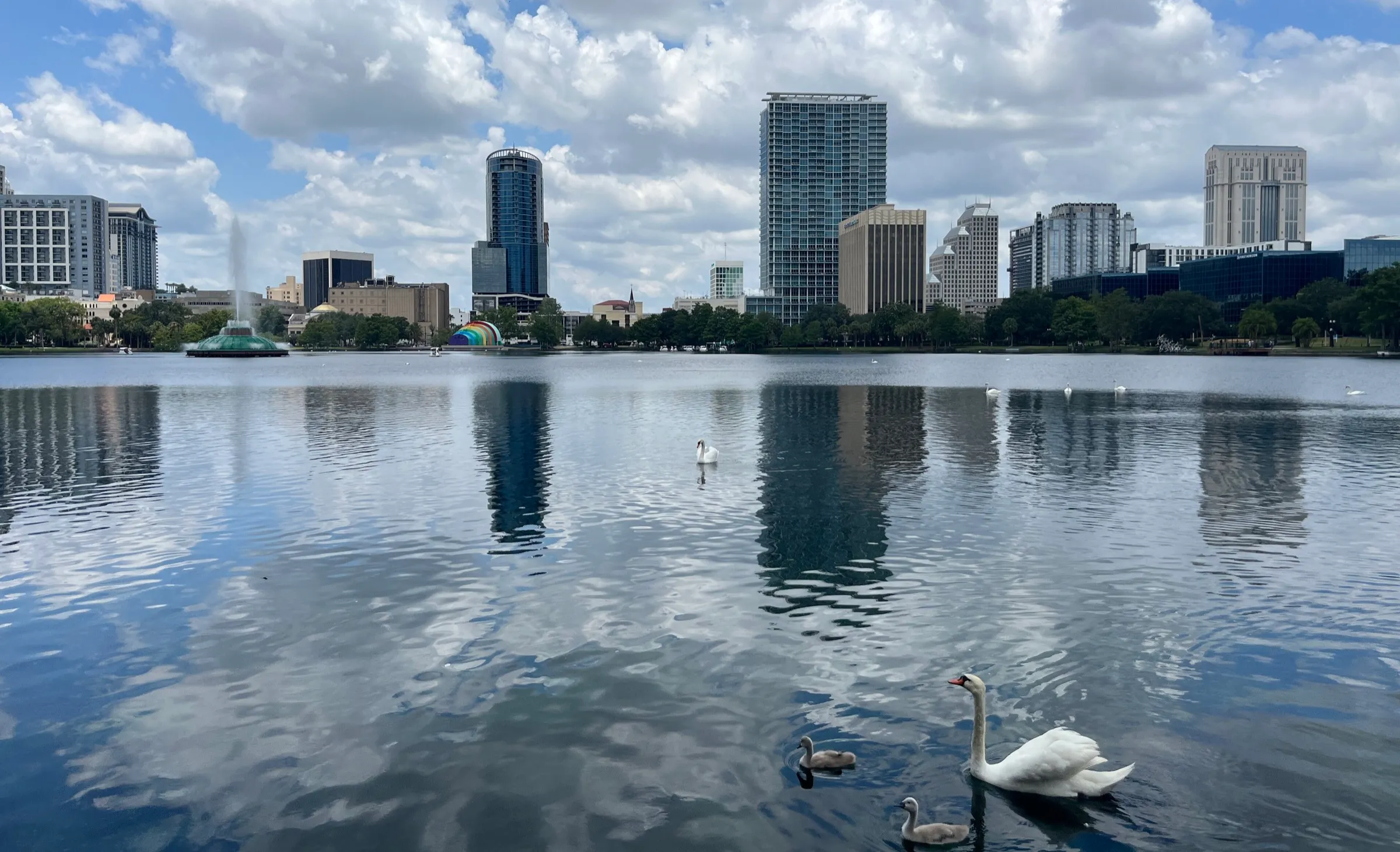
Orlando sits on limestone, which groundwater slowly dissolves. That is how sinkholes form, and since all of Florida is underlain by this rock, one could form almost anywhere.26 Lake Eola, downtown’s best-known lake, is itself a sinkhole; the city counts more than 100 lakes in all.25
For any home you’re considering, our safety guide shows how to look up its flood zone and what to ask a builder about wind ratings.
Taxes
Florida has no personal income tax.9 The state collects a 6% sales tax,10 and each county may add a surtax: 0.5% in Orange County, for 6.5% in all, and 1.5% in Osceola County, for 7.5% in all.11
Property tax is where Florida collects instead. In the communities we cover, the 2026 rate runs from 13.83 to 18.03 mills, or about $14 to $18 a year for every $1,000 of taxable value. If you live in the home, the homestead exemption lowers the taxable value and caps how fast it can rise; our guide to buying costs works through an example. Many new communities add a CDD fee on the same bill.
Getting around
Orlando is built around the car. Interstate 4 runs southwest to northeast through downtown, and toll roads (SR 408, SR 417, SR 429 and the Turnpike) loop around it. Many of the new communities we cover sit near SR 429 or SR 417, so budget for tolls if you’ll commute.
- SunRail, the commuter train, runs 61 miles with 17 stations, from DeLand in Volusia County through downtown Orlando to Poinciana, south of Kissimmee.12
- Brightline has run from a station at Orlando International Airport to South Florida since September 22, 2023, with stops including West Palm Beach, Fort Lauderdale and Miami.13
- LYNX buses serve Orange, Osceola and parts of Seminole counties.14
- Orlando International Airport handled 57,675,573 passengers in 2025.15
Drive times from each community to downtown, the airport and Disney are in our schools and commute guide.
What it costs to live here
Overall, prices in the Orlando metro run close to the national average. The Bureau of Economic Analysis puts them at 101.4 for 2024, where the U.S. is 100.19 Housing is the part that varies most:
- Buying: the median home sold in the Orlando area in September 2026 went for $399,610, all home types, new and resale.21
- Renting: HUD’s fair market rent for a two-bedroom across the metro is $1,972 a month for 2026.20
- New homes: builders’ starting prices in the communities we cover are in ourprices guide, and themonthly-cost guide adds the mortgage, taxes and fees.
Homeowners insurance is a large cost in Florida. Our buying-costs guide has the county averages for homeowners insurance.
Jobs and the economy
Tourism is the base: Orlando had a record 76.7 million visitors in 2025, more than any other U.S. destination.16 Health care, aerospace and the University of Central Florida, with 70,674 students in fall 2025,18 add a second layer. The largest private employers in the metro:17
| Employer | Employees |
|---|---|
| Walt Disney World Resort | 80,000 |
| AdventHealth | 40,000 |
| Universal Orlando Resort | 32,000 |
| Orlando Health | 30,600 |
| University of Central Florida | 13,500 |
| Lockheed Martin | 10,500 |
The list leaves out local governments, nonprofits and retailers.
Setting up utilities
Who supplies your electricity depends on where the home is, not its mailing address. Ask the builder before closing:
- OUC (Orlando Utilities Commission) serves the cities of Orlando and St. Cloud and parts of unincorporated Orange and Osceola counties.22
- Duke Energy Florida serves much of the rest of the region, including parts of Orange, Osceola, Seminole and Lake counties.23
- Kissimmee Utility Authority serves about 100,000 customers in and around Kissimmee.24
Water and sewer usually come from the city or county, and in some new communities from a private utility the developer set up. The community’s HOA can tell you which.
Where people are buying new
New construction in greater Orlando is concentrated on the edges, where there is land. The areas we cover, by their lowest builder starting price:
- Lake Nona: new homes from $382,990 · Tavistock's 17-square-mile planned community in southeast Orlando, next door to Orlando International Airport.
- Horizon West: new homes from $434,990 · Orange County's planned district of villages southwest of Winter Garden, a short drive from Disney.
- St. Cloud: new homes from $449,990 · The area around the city of St. Cloud in Osceola County, southeast of Lake Nona.
To see them sorted by what you put first, read the best places to live near Orlando, or compare every community on price, fees and schools.
Sources
- U.S. Census Bureau: City and town population estimates, Vintage 2025 (Florida)
- U.S. Census Bureau: Metropolitan area population estimates, Vintage 2025
- USGS Geographic Names Information System: Orlando (feature 288240)
- National Weather Service Melbourne: Orlando climate normals, 1991–2020
- National Hurricane Center: Tropical cyclone climatology
- National Weather Service Melbourne: Hurricane Milton post-tropical cyclone report
- National Hurricane Center: Tropical Cyclone Report, Hurricane Ian
- National Weather Service Melbourne: Lightning information
- Florida Department of Revenue: Report tax violations (no personal income tax)
- Florida Department of Revenue: Sales and use tax
- Florida Department of Revenue: Discretionary sales surtax rates, 2026 (DR-15DSS)
- SunRail: About SunRail
- Brightline: Orlando service launch, September 2023
- LYNX: Central Florida Regional Transportation Authority
- Greater Orlando Aviation Authority: Traffic summary, calendar year 2025
- Visit Orlando: Record 76.7 million visitors in 2025
- Orlando Economic Partnership: Top 50 employers, Orlando MSA (October 2026)
- University of Central Florida: UCF facts
- U.S. Bureau of Economic Analysis via FRED: Regional price parity, all items, Orlando-Kissimmee-Sanford
- HUD: Fair Market Rents, FY2026, Orlando-Kissimmee-Sanford MSA
- Orlando Regional REALTOR® Association: Housing Market Narrative, September 2026
- OUC: Newsroom (service area)
- Duke Energy Florida: Hurricane Milton restoration update (counties served)
- Kissimmee Utility Authority: About KUA
- City of Orlando: 40 fun Orlando facts
- Florida Geological Survey: Sinkhole FAQ
Population figures are Census Bureau estimates for July 1, 2025; the 2020 comparison uses the Bureau’s April 2020 estimates base.